


This guest article is generously provided by Greg McRay founder and CEO of the Foundation Group.
Whether you’re leading a church, ministry, or faith-based organization, it takes funds to fulfill your mission. Donations are critical to both sustaining and expanding your organization’s efforts.
There are myriad ways to raise funds and support, from online campaigns to outreach events. However, faith-based fundraising presents unique considerations, such as financial scrutiny and community expectations, that necessitate a careful approach.
In this guide, we’ll explore how to solicit charitable donations and maximize faith-based fundraising success.
1. Understand compliance requirements.
Fundraising compliance requirements vary depending on several factors, such as the organization type or the state in which it operates. For example, Foundation Group’s guide to planting a church explains that your church may need to complete charitable solicitations registration before requesting donations, depending on your state’s laws and whether or not your church obtains an official 501(c)(3) determination.
While most states don’t require churches to register, 40 states require registration from nonprofits. If you’re fundraising for a faith-based nonprofit, you may have to apply for charitable solicitations registration unless your organization is based in one of the following states:
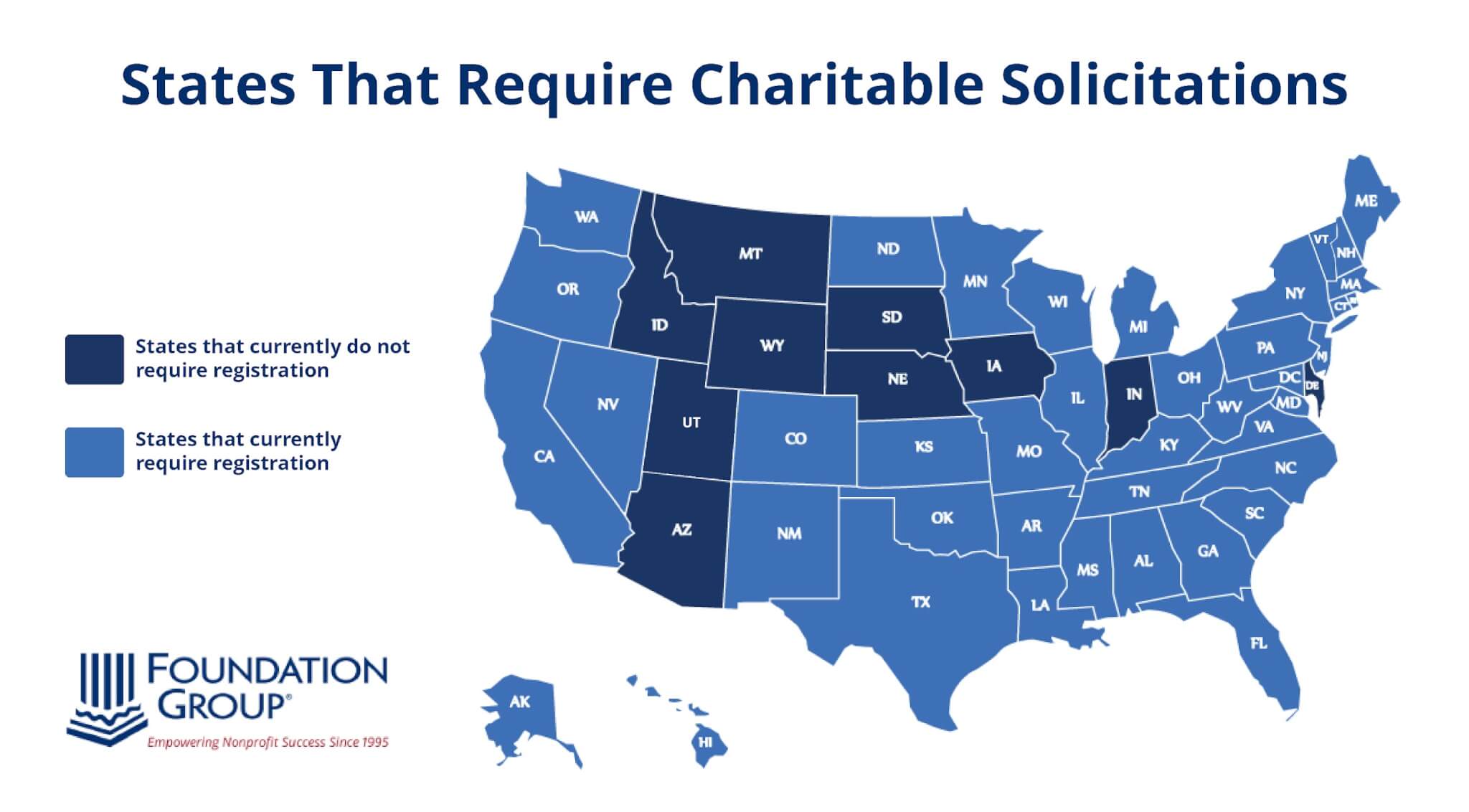
- Arizona
- Delaware
- Idaho
- Indiana
- Iowa
- Montana
- Nebraska
- South Dakota
- Utah
- Wyoming
Always double-check the exact requirements in your jurisdiction to determine whether your organization or church needs to register.
Compliance requirements extend beyond soliciting donations—financial reporting requirements also come into play after you’ve received donations. A religious nonprofit with 501(c)(3) status, for example, must file Form 990 annually, while a church doesn’t need to.
Additionally, your organization’s legal structure impacts the compliance standards you must follow when fundraising. For example, churches need official 501(c)(3) determination to ensure donations are tax-deductible and prove that the organization satisfies the necessary requirements to qualify for tax-exempt status.
2. Build your fundraising team.
Between marketing campaigns, selling event tickets, monitoring progress, and every other fundraising task, your organization needs manpower to execute its fundraiser successfully. Assembling a team of passionate, faith-aligned individuals ensures your efforts are supported by like-minded individuals and align with your overall mission.
Team members could include:
- Employees: Individuals who already work for your church or nonprofit are among the best suited to join your fundraising efforts because of their involvement with and affinity for your organization. Plus, many staff members may already handle tasks essential to your fundraiser (i.e., your marketing team can promote the fundraiser).
- Volunteers: According to Double the Donation’s volunteer statistics, approximately 1 in 3 American volunteers donate their time to religious organizations. If your organization already taps into this significant source of support, fundraising can be easily added to most job descriptions. For example, volunteers for a children’s ministry may normally facilitate Sunday school lessons, but they could also be recruited to set up for an upcoming auction fundraiser.
- Community members: Volunteers from similar organizations, congregants from sister churches, and various other community members may contribute to your fundraising team due to their affinity for your cause.
While your fundraising team is responsible for running your campaign, it’s up to you to prepare them for the role. The right volunteer management practices ensure your team is equipped and confident to carry out their assigned tasks and maximize your fundraising success.
3. Consult a bookkeeping expert.
Bookkeeping is critical to faith-based fundraising because it ensures transparency, accountability, and efficiency in managing funds. Successfully soliciting charitable donations necessitates precise financial tracking, which must be in place before fundraising begins.
Before your organization receives donations, implement an efficient bookkeeping system to keep organized and accurate records. This could include recording financial transactions with a digital tool or physical ledger or entrusting the task to a professional bookkeeper.
A dedicated bookkeeper is especially beneficial to faith-based fundraising because church and religious organization leaders often have a full workload and little bookkeeping expertise. Should your organization choose to outsource, a professional will:
- Record all transactions: Bookkeepers document transactions as they occur in thorough detail.
- Reconcile your books: Each month, your bookkeeper will compare donor activity to financial data to identify any errors or mistakes.
- Produce financial statements: On a recurring basis, bookkeepers will summarize financial data in four reports: Statement of Financial Position, Statement of Activities, Statement of Cash Flow, and Statement of Functional Expenses.
These roles enable your organization to create an accurate budget by providing reliable financial data and insights. Additionally, a thoughtful financial approach fosters donor trust, especially when you transparently provide financial statements to donors who want to see them.
In other words, consulting a professional bookkeeper allows your organization to achieve optimal financial practices without sacrificing its focus on what matters most: its mission.
4. Make the ask.
With all of the right technology and best practices in place, the only step left to soliciting charitable donations is just that: solicitation. Develop a list of fundraising ideas, keeping compliance in mind as you plan. For example, your fundraising team should consider:
- Games of chance: While raffles and lotteries are bound to excite donors, these types of fundraisers are sometimes subject to state regulations. Verify whether your state allows such activities and whether you need to obtain any necessary permits.
- Outreach restrictions: Activities such as writing church fundraising letters or sending fundraising eCards may be permissible if the recipient has donated in the past and provided their contact information. However, your organization should follow CAN-SPAM guidelines, especially when reaching out to prospective donors.
- Donor privacy: As you collect donations, your organization will inevitably handle sensitive donor data. Safeguard this information, such as payment data and contact details, by prioritizing secure data storage and transmission.
If your fundraising team is unfamiliar with the standards it must follow when soliciting donations, consult a nonprofit compliance expert. These professionals are well-versed in the standards that apply to your organization and can provide advice as you create a fundraising plan that adheres to them.
From event registration software to digital bookkeeping solutions, numerous tools exist to support the fundraising process for organizations like yours. The right tools can make your ask convenient, compelling, and compliant with fundraising requirements.
Remember to train staff members and volunteers on how to use any software your organization uses. Fostering confidence among team members by helping them feel comfortable using your tech can not only maximize your fundraising efficiency but also increase employee engagement.
About the Author: Greg McRay, Foundation Group 
Greg is the founder and CEO of Foundation Group, one of the nation’s top providers of tax and compliance services to nonprofits. Greg and his team have worked with tens of thousands of nonprofits for over 25 years, assisting them with formation of new charities, plus tax, bookkeeping, and compliance services. He is credentialed as an Enrolled Agent, the highest designation of tax specialist recognized by the Internal Revenue Service. Based in Nashville, Tennessee, Greg and company work with charities and nonprofits all across the country and worldwide.
